
 SpectraDx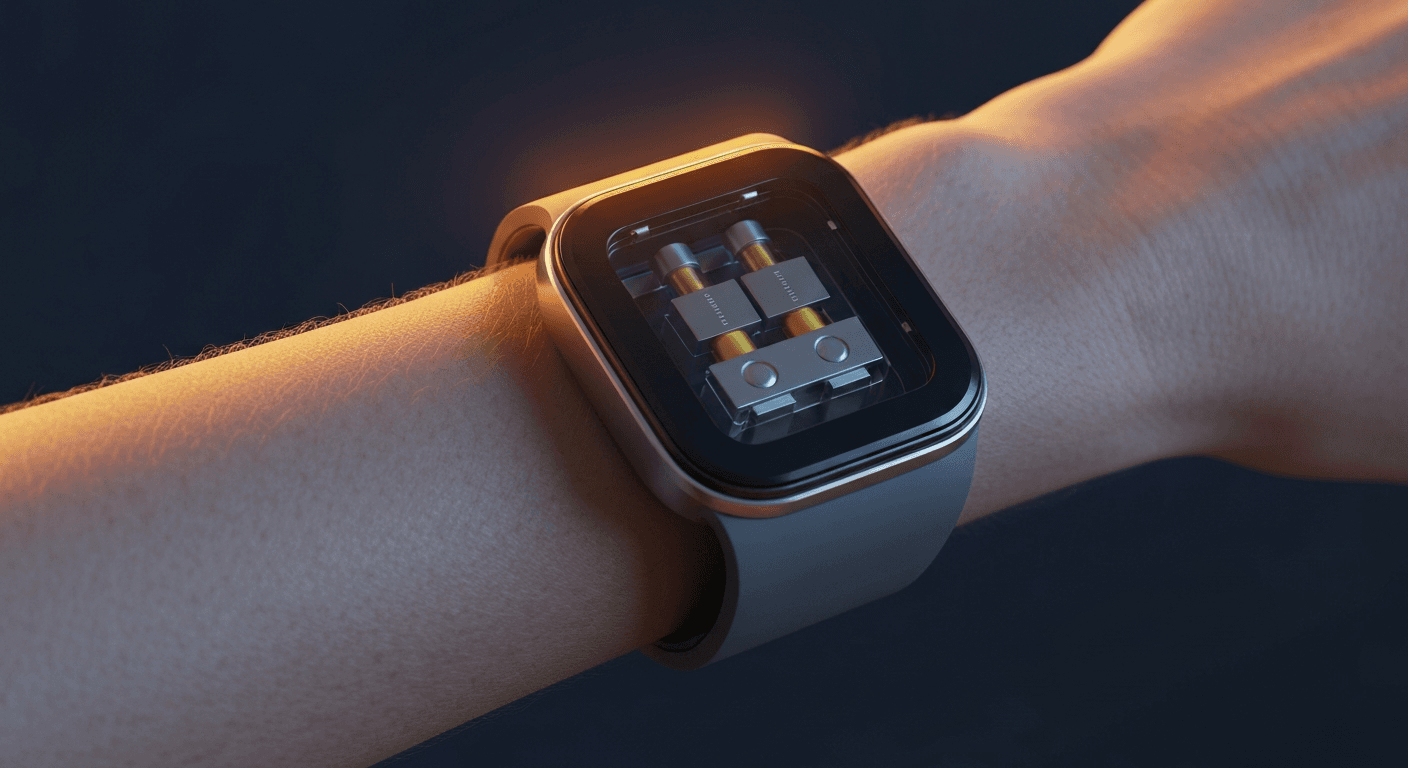
A flexible gold nanomesh patch, thinner than a bandage, adheres to the skin and continuously detects cortisol, uric acid, and glucose in sweat at micromolar concentrations. A silicon photonics chip the size of a fingernail resolves near-infrared absorption spectra across 1,250 to 2,500 nm. A compact Raman device achieves 11.69% MARD for glucose monitoring - comparable to the Dexcom G7.
None of these are consumer products yet. All of them exist in laboratories. The distance between the two is where the story of wearable spectroscopy lives.
This article maps the current state of wearable spectroscopy: what works, what is close, what is far away, and what the physics allows. It covers SERS smart skin sensors, NIR wearable devices, miniaturized spectrometer technology, and the software and regulatory infrastructure required to move from research prototypes to products that clinicians and consumers can use.
SERS Smart Skin Sensors
Surface-enhanced Raman spectroscopy on flexible, wearable substrates is the most scientifically ambitious approach to continuous molecular monitoring. The concept: a conformal SERS substrate worn on the body detects specific biomarkers in sweat through molecular fingerprinting, providing continuous, label-free chemical sensing without the reagents, enzymes, or electrochemical reactions that conventional biosensors require.
The substrate challenge
A wearable SERS sensor must satisfy requirements that conflict with each other:
- Mechanically flexible - conformal to skin curvature and body motion
- Optically active - maintaining plasmonic enhancement under deformation
- Chemically stable - resisting degradation from sweat, temperature, and mechanical stress for days
- Manufacturable at scale - not requiring electron beam lithography
Recent substrate innovations have made significant progress:
Gold nanomesh. Liu et al. developed ultrathin, stretchable, adhesive gold nanomesh structures enabling label-free SERS detection across a 10 to 10^6 nM concentration range. The key dimensions - wire diameter of 490 nm with 150 nm gold thickness on PVA nanofiber mesh - produce consistent hotspots across the mesh surface.
FlexoSERS. Hierarchically oriented gold nanowire architectures, described as "jellyfish-like," provide ultrasensitive SERS signal even under 50% mechanical strain, with an enhancement factor of 3.3 x 10^10 (Nano Letters, 2024). The structure successfully detects uric acid in both artificial and human sweat and functions as a pH sensor across pH 4.2 to 7.8.
Heart-shaped nanodimers. Chowdhury et al. created stretchable SERS sensors with nanodimer structures on PDMS that maintain performance under bending up to 100 degrees and stretching up to 50% - the range of deformation encountered on the body during normal activity.
What wearable SERS can detect
Sweat contains a surprising range of clinically relevant biomarkers at concentrations accessible to SERS:
| Biomarker | Detection Limit | Clinical Relevance |
|---|---|---|
| Lactate | 0.7 µM | Exercise intensity, tissue oxygenation |
| Urea | 0.6 µM | Kidney function, hydration status |
| Glucose | 0.7 µM | Metabolic monitoring (caveat: sweat glucose correlation with blood glucose is debated) |
| Uric acid | Low µM range | Gout risk, cardiovascular health |
| Cortisol | Sub-µM (LSPR aptamer-based) | Stress monitoring, adrenal function |
| Acetaminophen | 0.13 µM | Drug monitoring, overdose detection |
| pH | Resolution 0.14-0.51 | Skin health, metabolic state |
Key research groups
Wei Gao's laboratory at Caltech is the leading group in wearable sweat sensors. Gao, promoted to full professor in 2024, published a 2025 paper in Nature Materials on printable molecule-selective core-shell cubic nanoparticles for continuous noninvasive biomarker monitoring. Earlier work in Nature Nanotechnology (2024) demonstrated hormone detection (cortisol, female reproductive hormones) from sweat. The group's "Diving into sweat" review in ACS Nano (2024) provides a full overview of the field.
Other active groups include He et al. (microfluidic nanoplasmonic sensors for multiplexed sweat analysis), Wang et al. (stretchable spiral fractal electrodes with Ag nanocube metafilms), and multiple groups integrating SERS with microfluidic channels for controlled sweat sampling and transport.
Sensor durability
Current wearable SERS sensors achieve:
- Sensor thickness below 10 µm
- Air stability exceeding 30 days
- Mechanical durability over 100 deformation cycles
- Integration with microfluidic channels for sweat collection
- Wireless data transmission via Bluetooth or NFC
A 2025 review in Sensors (Khonina and Kazanskiy) and a feature in Spectroscopy Online thoroughly cover the current state of wearable plasmonic sensors.
The sweat glucose caveat
Sweat-based glucose monitoring deserves a specific caution. While SERS can detect glucose in sweat at clinically relevant concentrations, the correlation between sweat glucose and blood glucose is physiologically complex and not fully validated. Sweat glucose concentration depends on sweat rate, local skin conditions, and the time lag between blood glucose changes and sweat glucose changes. No regulatory body has cleared a sweat-based glucose monitor for diabetes management. For a detailed analysis of non-invasive glucose monitoring, see our NIR blood glucose monitoring article.
NIR Wearable Devices
Near-infrared sensing in consumer wearables is already shipping - but what is actually in these devices is often less than the marketing implies.
Apple Watch: SpO2 via discrete-wavelength PPG
The Apple Watch measures blood oxygen saturation (SpO2) using reflective photoplethysmography (PPG) with LEDs at approximately 660 nm (red), 850 nm (infrared), and 525 nm (green). Photodiodes measure the ratio of reflected red-to-infrared light, which changes with hemoglobin oxygenation.
This is spectral measurement in a basic sense - it exploits the different absorption spectra of oxyhemoglobin and deoxyhemoglobin - but it measures at discrete wavelengths rather than resolving a continuous spectrum. It demonstrates that consumer-grade optical hardware can extract physiologically meaningful signals from the wrist, but the leap from two-wavelength ratiometric measurement to broadband spectroscopy is enormous.
Samsung Galaxy Ring
The Galaxy Ring uses PPG sensors for heart rate and SpO2, bioelectrical impedance analysis (BIA), skin temperature, accelerometer, and gyroscope. Despite persistent rumors about advanced spectral sensing, there is no evidence that the current Galaxy Ring includes NIR spectroscopy beyond standard PPG wavelengths. The Galaxy Ring 2 is not expected until late 2026 or 2027, delayed partly by a patent dispute with Oura. Samsung patent filings describe expanded optical sensor arrays and blood pressure monitoring, but no spectral features have been confirmed.
Rockley Photonics: the cautionary tale and the comeback
Rockley Photonics represents both the promise and the peril of wearable spectroscopy commercialization. The company developed silicon photonics-based sensors for wearable health monitoring - a "clinic-on-the-wrist" vision integrating multiple spectroscopic measurements into a compact photonic integrated circuit chipset.
Rockley went public via SPAC in 2021, filed for Chapter 11 bankruptcy in January 2023, and emerged after 46 days with $35 million in new funding. In December 2023, they began sampling the Bioptx Biosensing Band to strategic customers - a wristband using short-wave infrared (SWIR) laser-based spectroscopy for body temperature, hydration, heart rate, HRV, respiratory rate, and SpO2, with non-invasive glucose and cuffless blood pressure in development.
In October 2024, Celestial AI acquired Rockley's silicon photonics patent portfolio (200+ patents) for $20 million - but for data center AI applications, not biosensing. As of late 2024, Rockley had approximately 230 employees and continues biosensing development, but no confirmed mass-market consumer product has shipped.
The lesson: even with $300+ million in funding, a talented photonics team, and a viable miniaturized sensor architecture, the path from laboratory demonstration to a consumer product that meets FDA accuracy standards takes longer and costs more than investors typically tolerate.
Liom: Raman-based glucose
Liom, a Swiss company founded in 2017, is taking a different approach: Raman spectroscopy with AI for fully non-invasive, calibration-free glucose monitoring. They reported achieving a 12x improvement in light throughput over lab-scale Raman devices in a wearable form factor - a critical engineering milestone, since the weakness of Raman scattering signals is the fundamental barrier to miniaturization.
Liom has raised CHF 63 million in total funding (including a Series A of CHF 38 million), with Red Bull Ventures and Marc Maurer (former co-CEO of On Running) among investors. Pre-launch sales are planned for the first half of 2026, with shipping targeted for mid-2027 and commercial launch in 2028.
MIT band-pass Raman device
The most technically impressive result in non-invasive spectroscopic glucose monitoring comes from Jeon Woong Kang's team at MIT, published in Analytical Chemistry in December 2025. Their compact band-pass Raman device achieved 11.69% MARD for glucose - comparable to the Dexcom G7 (11.45%) and Abbott FreeStyle Libre 3 (12.31%). 100% of readings fell within Clarke Error Grid zones A and B.
The current device is 31 x 27 x 21 cm - tabletop, not wearable. A cellphone-sized prototype is in development, with a watch-sized form factor as the long-term target. Key specifications:
- Laser: 830 nm at 110 mW
- Measurement time: approximately 36 seconds
- Detector: femtowatt silicon photoreceiver for high-sensitivity detection
This result is potentially transformative if the device can be miniaturized without sacrificing signal-to-noise ratio. The 830 nm wavelength avoids the water absorption problems that plague NIR glucose sensing, and Raman scattering provides molecular specificity that broadband absorption measurements lack.
Biolinq Shine: the first needle-free glucose sensor
Biolinq received FDA De Novo classification in September 2025 for the Biolinq Shine - the first fully autonomous, needle-free glucose sensor. The device uses a microsensor array that measures glucose in the top layers of skin, 20 times shallower than traditional CGMs, with color-coded LED feedback directly on the device.
Biolinq Shine is not spectroscopy-based - it uses electrochemical sensing - but its FDA clearance is significant for the wearable spectroscopy field because it:
- Established a regulatory precedent for novel non-invasive glucose sensing technologies
- Created a new device classification category
Miniaturized Spectrometer Technology
A wearable spectroscopic sensor needs a spectrometer small enough to fit on the body, low enough power to run on a battery, and sufficient spectral resolution to extract meaningful chemical information. Four miniaturization approaches are competing.
MEMS Fabry-Pérot interferometers
MEMS-based Fabry-Pérot interferometers (FPIs) use electrostatically tunable mirrors to scan across wavelengths. The technology, developed by VTT Technical Research Centre of Finland and commercialized by Spectral Engines, produces compact NIR spectrometers in module-sized packages.
The Spectral Engines NIRONE Sensor X covers 1,550 to 1,950 nm - a useful NIR window for organic molecule detection. FPI-based sensors offer lower power consumption than grating or Fourier-transform approaches because they have no moving gratings or detector arrays, just two parallel mirrors with a tunable gap.
Photonic integrated circuits
Photonic integrated circuits (PICs) integrate optical components - waveguides, filters, detectors - on a single semiconductor chip. This is the approach Rockley Photonics pursued for their biosensing wristband.
The most striking result comes from Aalto University, published in Science Advances in January 2025: a spectrometer on a 5 µm × 5 µm chip using a tunable optoelectronic interface, achieving peak wavelength identification accuracy of approximately 0.2 nm. The spinoff company Agate Sensors raised EUR 5.6 million in seed funding (led by Voima Ventures and LIFTT) for commercialization.
At the chip scale, computational spectroscopy becomes essential - the tiny sensor collects less light and fewer spectral channels than a benchtop instrument, and AI algorithms reconstruct the full spectrum from the limited measurements.
Linear variable filters
Linear variable filters (LVFs) are thin-film coatings whose passband varies linearly along one dimension. Paired with a linear photodetector array, they create a compact spectrometer with no moving parts. Current miniaturized LVF spectrometers achieve 970 to 1,630 nm range with 15 nm resolution in a 71 mm diameter package, with further miniaturization underway through computational methods.
FT-IR on a chip: Si-Ware NeoSpectra
Si-Ware Systems' NeoSpectra Micro is arguably the most commercially mature miniaturized spectrometer: an 18 × 18 × 4 mm module covering 1,250 to 2,500 nm at 8 or 16 nm resolution using their SiMOST (Silicon Monolithic Optical Scanning Technology) - a MEMS-based Michelson interferometer fabricated entirely in silicon.
The NeoSpectra covers the broadest NIR range of any miniaturized spectrometer at a size viable for handheld devices, though still too large for watch-scale wearables. It has moved into volume production and is being integrated into handheld analyzers for food, agriculture, and industrial applications.
Comparison
| Company | Product | Size | Spectral Range | Resolution | Technology |
|---|---|---|---|---|---|
| Si-Ware Systems | NeoSpectra Micro | 18×18×4 mm | 1,250-2,500 nm | 8-16 nm | MEMS FT-IR |
| Hamamatsu | C12880MA | 20×12.5×10 mm, 5g | 340-850 nm | 15 nm | CMOS + concave grating |
| nanoLambda | NSP32m | ~500 µm height (BGA) | 340-1,010 nm | N/A | Plasmonic filter array |
| Spectral Engines | NIRONE Sensor X | Module-sized | 1,550-1,950 nm | N/A | MEMS FPI |
| TI | DLP NIRscan Nano | Handheld EVM | NIR | Configurable | DLP + diffraction grating |
| Aalto/Agate | Chip sensor | 5×5 µm | Visible | ~0.2 nm | Tunable optoelectronic PIC |
The trade-off is clear: smaller spectrometers cover narrower spectral ranges, achieve lower spectral resolution, and collect less light (lower SNR). A wearable that needs to measure glucose via NIR absorption requires broad spectral coverage (to separate glucose from confounders) with high SNR (to detect the tiny glucose signal through tissue) - requirements that current chip-scale spectrometers cannot simultaneously satisfy.
Software Challenges for Continuous Monitoring
A wearable spectroscopic sensor generates a continuous stream of spectral data on a device with constrained processing power, limited battery, and intermittent connectivity. The software stack must handle real-time spectral processing, drift compensation, alert generation, and longitudinal analytics.
Edge processing on constrained hardware
The spectral processing pipeline - baseline correction, normalization, feature extraction, and classification - must run on the wearable device itself for real-time feedback. This means lightweight models: decision trees, small CNNs for time-series classification, and threshold-based anomaly detectors rather than large transformer models.
Sub-250 ms latency for context-sensitive alerts is the target for clinical applications. Autoencoder-based preprocessing can compensate for signal degradation from sensor drift without requiring full model retraining. Isolation forests running on edge hardware can flag outlier readings for cloud-side verification.
Drift compensation
Wearable spectroscopic sensors drift. Multiple factors contribute simultaneously:
- The SERS substrate degrades over time
- Sweat composition varies with hydration, temperature, and activity
- Optical coupling between sensor and skin changes with body position and strap tension
- Ambient temperature shifts the spectral response
Drift compensation requires continuous auto-calibration - typically shallow feedforward neural networks or non-linear regression models running in the background, using internal reference signals (known Raman peaks from the substrate material, calibration wavelengths from on-device LEDs) to adjust the measurement model in real time.
Long-term wear trials across different skin types, body locations, and activity levels are essential for characterizing drift patterns and validating compensation algorithms - data that most research groups have not yet collected.
Cloud analytics for longitudinal trends
While real-time processing happens at the edge, longitudinal trend analysis - tracking biomarker levels over days, weeks, and months - requires cloud infrastructure. Hybrid edge-cloud architectures send summarized measurements (not raw spectra) to the cloud for:
- Longitudinal trend visualization and pattern detection
- Multi-patient aggregation for population health insights
- Autoencoder-based anomaly detection trained on normal physiological patterns
- Personalized baseline establishment through initial calibration periods
Adaptive alert thresholds - using rolling window statistics and contextual awareness (activity level, time of day, meal timing) - reduce false alarms while maintaining sensitivity to genuine physiological changes.
Regulatory Landscape
FDA: wellness versus clinical
The FDA's revised guidance on General Wellness Policy for Low Risk Devices (January 6, 2026) clarified a critical distinction for wearable spectroscopy. Whether a non-invasive wearable qualifies as a general wellness product depends on how it is advertised and promoted, not on the underlying sensing technology.
Non-invasive wearables measuring activity, recovery, sleep, pulse, or fitness-related biomarkers generally qualify as low-risk wellness products if their claims avoid disease references. An optical blood pressure wearable may qualify as a wellness product if non-diagnostic - directly relevant to spectroscopy-based devices measuring physiological parameters like hydration or stress biomarkers.
But a spectroscopy-based device that claims to diagnose disease, monitor a clinical condition, or guide treatment decisions requires FDA clearance or approval as a medical device. The Biolinq Shine used the De Novo pathway - appropriate for novel devices with no predicate - and created a new regulatory category for needle-free glucose sensors.
For wearable spectroscopy companies, the practical implication: you can ship a wellness device faster by avoiding clinical claims, but the clinical claims are where the real value lies. Samsung and Apple have navigated this tension with their SpO2 features - launched as wellness features in some markets, with clinical claims pending in others.
The FDA has explicitly warned consumers not to rely on unauthorized smartwatches or rings claiming glucose measurement capability. Any wearable spectroscopy device making quantitative glucose claims will face rigorous regulatory scrutiny.
EU MDR
Under the EU Medical Device Regulation, software monitoring physiological processes is classified as Class IIa. If monitoring vital parameters where variations could cause immediate danger, it is classified as Class IIb. A 2025 proposal to simplify MDR would allow some medical software to be classified as Class I instead of IIa, but introduces criteria for "serious" or "critical" situations that trigger higher classification.
Wearable spectroscopy devices making clinical claims would likely require Class IIa or IIb CE marking with Notified Body assessment - a process that typically takes 12 to 18 months and requires clinical evidence.
Market Outlook and Timeline
What arrives when
The timeline for wearable spectroscopy is gated by three factors: miniaturization of the optics, validation of the clinical accuracy, and regulatory clearance. Different applications face different bottlenecks.
Already shipping (2024-2026):
- SpO2, heart rate, HRV, skin temperature via PPG - all using discrete-wavelength optical sensing, not broadband spectroscopy
- Fitness and recovery metrics from optical and electrical sensors
Near-term (2026-2028):
- Hydration monitoring via multi-wavelength NIR or impedance
- Sweat electrolyte monitoring (research-grade wearable patches moving toward consumer products)
- Sleep quality biomarkers from multi-modal sensor fusion
Medium-term (2028-2030):
- Non-invasive glucose monitoring via Raman (Liom targeting 2028 launch) or NIR (if accuracy challenges are resolved)
- Wearable SERS patches for sweat biomarker panels (lactate, uric acid, cortisol) - initially for sports medicine and wellness
- Cuffless blood pressure via spectral and PPG sensor fusion
Longer-term (2030+):
- Multi-analyte clinical-grade wearable diagnostics
- Real-time therapeutic drug monitoring (tracking drug levels in sweat)
- Wearable SERS for cancer biomarker screening in high-risk populations
- Continuous metabolite panels replacing periodic blood draws
The investment landscape
Capital is flowing into wearable health sensing, though not always into spectroscopy specifically:
| Company | Funding/Valuation | Technology | Status |
|---|---|---|---|
| Oura | $900M Series E (Oct 2025) | PPG, temperature, accelerometer | Consumer product shipping |
| Whoop | $575M Series G, $10.1B valuation (Apr 2026) | PPG, accelerometer; Abbott + Mayo Clinic investors | Consumer product shipping |
| Liom | CHF 63M total | Raman glucose spectroscopy | Pre-launch 2026, shipping 2027 |
| Agate Sensors | EUR 5.6M seed | Chip-scale PIC spectrometer | R&D, commercialization |
| Rockley Photonics | $300M+ historical; emerged from Chapter 11 | Silicon photonics SWIR | Sampling Bioptx band |
| Biolinq | Undisclosed | Needle-free electrochemical glucose | FDA De Novo cleared (Sep 2025) |
The pattern: companies with consumer-grade PPG sensors (Oura, Whoop) are attracting massive valuations. Companies pursuing spectroscopy-based sensing (Liom, Rockley) are smaller and earlier-stage. The market is rewarding what ships, not what measures more.
The critical question: will the physics cooperate?
The fundamental challenge for wearable spectroscopy is signal-to-noise. Shrinking the spectrometer shrinks the detector area, reduces the optical path length, limits the spectral range, and increases noise - all simultaneously. A benchtop spectrometer can compensate with longer integration times, more powerful lasers, and larger detectors. A wearable cannot.
The MIT Raman glucose result (11.69% MARD) is the most encouraging data point because it demonstrates that the signal is there - glucose can be measured optically at clinically relevant accuracy. But the device that achieved it is 31 × 27 × 21 cm and uses a 110 mW laser. Getting equivalent performance into a watch-sized device requires breakthroughs in:
- Photonic integration: More efficient light collection and delivery on chip, potentially using resonant cavities or waveguide structures to increase effective path length without increasing physical size
- Detector sensitivity: Femtowatt-class photoreceivers (as MIT used) in miniaturized form factors
- AI-driven calibration: Models that incorporate contextual data (activity, meals, temperature, historical patterns) alongside spectral data to extract signal from noise
- Multi-modal sensor fusion: Combining spectroscopy with complementary sensors (PPG, bioimpedance, temperature) to provide orthogonal information that improves analyte estimation beyond what any single modality achieves
These are engineering challenges, not physics impossibilities. The signal exists. The question is whether it can be extracted reliably from a device small enough and cheap enough to wear.
What This Means for Clinical Spectroscopy
The wearable spectroscopy story is dramatic, but its timeline is measured in years, not months. For clinical laboratories building spectroscopy-based diagnostics today, the near-term relevance is in the technology spillover: miniaturized spectrometers developed for wearables will find applications in benchtop POC devices, SERS-based diagnostic platforms, and portable instruments for field use.
The NeoSpectra Micro, originally developed for consumer and industrial applications, is already being evaluated for clinical near-infrared analysis. Computational spectroscopy techniques developed for chip-scale sensors improve spectral preprocessing for conventional instruments. AI calibration methods designed for personalized wearable models advance transfer learning for cross-instrument generalization.
The wearable revolution, when it arrives, will not replace laboratory spectroscopy - it will extend it. Continuous monitoring generates data that complements point-in-time laboratory measurements. A patient who wears a spectroscopic sensor that tracks lactate, cortisol, and glucose continuously generates a physiological profile that no sequence of blood draws can match. The laboratory provides ground truth. The wearable provides the movie between the snapshots.
For the software platform that connects spectrometers to clinical workflows, the implication is clear: the instrument field is expanding from benchtop to handheld to wearable, and the clinical workflow software must be ready for all three.
Further Reading
- Non-Invasive Blood Glucose Monitoring with NIR Spectroscopy - the physics, the devices, and the realistic timeline
- SERS for Point-of-Care Diagnostics - substrate technologies and clinical applications that inform wearable SERS
- FTIR vs. Raman vs. NIR for Diagnostics - modality comparison for understanding wearable trade-offs
- Building AI Pipelines for Spectral Classification - the ML pipeline that wearable spectral data feeds into
- Synthetic Spectra Generation with Generative AI - solving the data scarcity problem that limited wearable training data creates
Part of the SpectraDx technical blog.