
 SpectraDx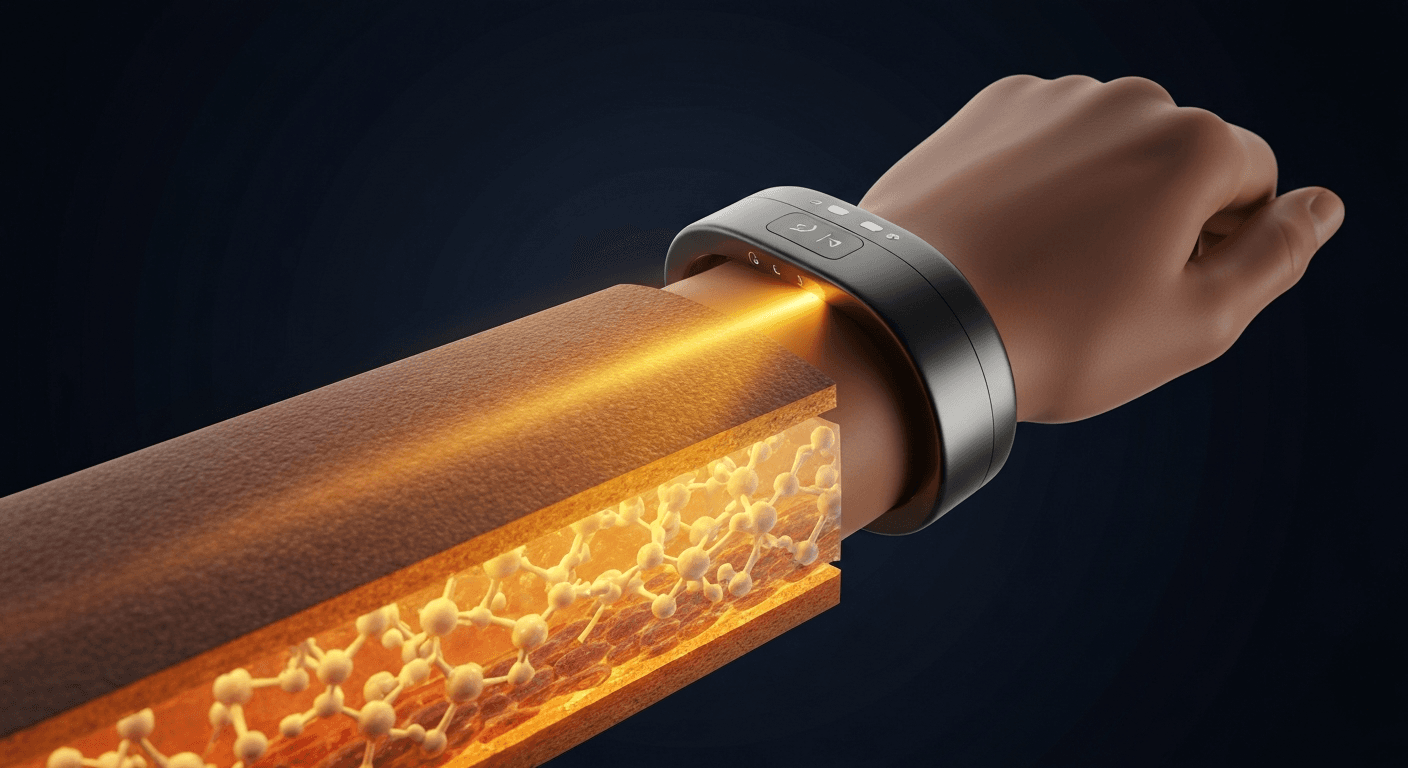
Non-invasive blood glucose monitoring has been the holy grail of NIR spectroscopy for thirty years. The pitch is irresistible: shine near-infrared light through the skin, detect glucose in the blood without a finger prick, and give 400 million diabetics worldwide a painless way to manage their disease.
Samsung, Apple, Glucube, and a dozen startups are actively pursuing this. Consumer electronics companies file glucose-sensing patents by the dozen. Headlines declare breakthroughs every few months. And yet, as of late 2026, no non-invasive spectroscopic glucose monitor has received FDA clearance for clinical or consumer use.
This article explains why the physics makes it so hard, what the leading efforts have actually demonstrated, and what a realistic timeline looks like - not to dismiss the technology, but to help you distinguish between genuine progress and hype.
Why NIR Spectroscopy Should Work for Glucose
The basic physics is sound. Glucose molecules absorb near-infrared light at specific wavelengths, primarily in the first overtone region around 1,550-1,750 nm and the combination band region near 2,100-2,300 nm. These absorption features arise from O-H and C-H bond vibrations in the glucose molecule. In theory, you measure the NIR absorption spectrum through the skin, identify the glucose-specific features, and calculate the blood glucose concentration.
This principle works reliably in controlled laboratory settings. Dissolve glucose in water at known concentrations, measure the NIR spectrum with a benchtop spectrometer, build a PLS (Partial Least Squares) calibration model, and you get accurate predictions. The chemistry is not in question.
The problem is everything between the laboratory and the human body.
Why It Is Extremely Difficult in Practice
The water problem
Human tissue is approximately 60-70% water by volume. Water has enormous NIR absorption, with broad bands centered near 1,450 nm and 1,940 nm that partially overlap with glucose absorption features. At physiological concentrations (70-180 mg/dL for normal individuals, up to 400+ mg/dL in uncontrolled diabetes), glucose contributes roughly 0.001-0.01% of the total NIR absorption signal. You are trying to detect a whisper in a thunderstorm.
To put this in quantitative terms: the molar absorptivity of glucose at its strongest NIR feature (~1,580 nm) is approximately 0.1 L/(mol·cm). At a blood glucose concentration of 100 mg/dL (5.5 mmol/L), the absorbance change through 1 mm of tissue is on the order of 10^-5 absorbance units. A high-end benchtop NIR spectrometer can reliably measure absorbance changes of 10^-4 AU. A wristwatch-sized sensor, with its shorter path length, lower signal-to-noise, and ambient light interference, needs to do significantly better.
Tissue scattering
When NIR light enters the skin, it does not travel in a straight line. It scatters off collagen fibers, cell membranes, fat droplets, and blood vessels, taking a tortuous path through the tissue before reaching the detector (if it reaches the detector at all). This scattering is wavelength-dependent and varies between individuals and even between measurement positions on the same person.
Scattering changes the effective path length of light through the tissue in unpredictable ways. Since Beer-Lambert absorption depends on path length, scattering variations introduce errors that can dwarf the glucose signal. Two measurements on the same person, same spot, same glucose level, taken one minute apart, can produce different spectra simply because the skin shifted slightly relative to the sensor.
Confounding analytes
Blood contains dozens of other molecules that absorb NIR light at wavelengths near glucose - hemoglobin, albumin, urea, lactate, triglycerides, and cholesterol all have NIR absorption features. Changes in any of these analytes can mimic or mask changes in glucose. A calibration model must disentangle glucose from all of these confounders, which requires either very high spectral resolution, very long measurement times to improve SNR, or both.
Skin variability
Multiple factors affect NIR transmission through the skin:
- Melanin concentration
- Skin thickness
- Hydration level
- Subcutaneous fat thickness
- Surface temperature
A model calibrated on one person's skin will perform differently on another person. Even within the same individual, changes in skin hydration (post-shower vs. dehydrated), surface temperature (cold hands vs. warm), and measurement pressure (sensor pressed firmly vs. lightly) introduce measurement variations that can exceed the glucose signal.
Temperature sensitivity
Water's NIR absorption spectrum shifts with temperature. Since skin temperature varies by several degrees throughout the day (and differs between body locations), temperature-induced spectral changes can be larger than glucose-induced changes. Any practical device must either measure and compensate for skin temperature or achieve temperature control at the measurement site - both non-trivial in a wearable form factor.
Current Devices and Clinical Evidence
Glucube
Glucube is arguably the most advanced non-invasive NIR glucose device in clinical development as of 2026. The South Korean company has reported clinical trial results showing a MARD (Mean Absolute Relative Difference) of approximately 11.4% and 99.26% of readings falling within zones A and B of the Clarke Error Grid in a supervised clinical trial.
What this means: Zone A of the Clarke Error Grid represents readings within 20% of the reference value (or within 20 mg/dL for readings below 70 mg/dL). Zone B represents readings that deviate further but would not lead to inappropriate treatment. A combined A+B of 99.26% is comparable to some continuous glucose monitors (CGMs).
What to watch for: These results were achieved in a supervised clinical setting with controlled conditions. The critical question is whether this performance holds up in real-world conditions - across diverse skin tones, body compositions, temperatures, activity levels, and measurement positions. Real-world accuracy almost always degrades from clinical trial performance. The company is pursuing regulatory clearance, but timelines have not been confirmed.
Samsung
Samsung has been actively developing spectroscopy-based health sensing for its Galaxy Watch and Galaxy Ring product lines. Samsung Semiconductor published research on a compact NIR sensor suitable for wristwatch integration, and Samsung Research has filed numerous patents related to non-invasive analyte measurement.
Samsung Advanced Institute of Technology (SAIT) has demonstrated Raman-based glucose sensing on a benchtop device, and Samsung has explored both NIR absorption and Raman scattering approaches. The Galaxy Ring, launched in 2024, includes health sensors but does not currently offer glucose monitoring.
The challenge for Samsung: Miniaturizing an NIR glucose sensor to fit in a smartwatch or ring while maintaining adequate signal-to-noise is the fundamental engineering problem. The short optical path length through a finger or wrist, combined with the limited power budget and physical space for photodetectors, makes the SNR challenge orders of magnitude harder than a benchtop measurement. Samsung has the engineering resources and semiconductor fabrication capabilities to push the miniaturization envelope, but physics sets a hard floor on how much signal you can extract from a given path length and measurement time.
Apple
Apple has invested heavily in spectroscopy-based health sensing. The company has filed dozens of patents related to optical glucose sensing, absorption spectroscopy, and photonic integrated circuits for wearable devices. Apple's acquisition of spectroscopy startup Spectral Edge (2019) and its extensive patent portfolio suggest a long-term commitment.
Apple Watch Series models already include optical heart rate sensors and blood oxygen sensors that use visible and NIR wavelengths. Extending this to glucose measurement is a logical next step, and Apple's patent filings describe architectures for multi-wavelength NIR sensing through the wrist.
Reality check: Apple files patents on technologies years before they ship (and some never ship). There has been no public announcement of a glucose monitoring feature on any Apple Watch model, and well-sourced reports indicate that Apple has repeatedly delayed glucose sensing due to accuracy challenges. The company's standard for shipping a health feature - FDA clearance for a mass-market consumer device - is the highest bar in the industry.
Rockley Photonics
Rockley Photonics developed silicon photonics-based sensors for wearable health monitoring, including glucose sensing via NIR spectroscopy. Their "clinic-on-the-wrist" vision integrated multiple spectroscopic measurements into a compact photonic chip. Rockley went public via SPAC in 2021 and filed for Chapter 11 bankruptcy in late 2023, citing the difficulty of commercializing the technology. Their intellectual property was acquired in the bankruptcy proceedings.
Rockley's trajectory is instructive: even with over $300 million in funding, a talented photonics team, and a viable miniaturized sensor architecture, the path from laboratory demonstration to a product that meets FDA accuracy standards proved longer and more expensive than investors would tolerate.
Know Labs
Know Labs (formerly KnowBio) has developed a non-invasive glucose sensing approach using radio frequency (RF) spectroscopy rather than NIR - they transmit electromagnetic signals through tissue and analyze the dielectric properties. While not strictly NIR, they are competing for the same non-invasive glucose monitoring market. The company has reported correlation data but has not achieved FDA clearance as of 2026.
The Competitive Approaches
NIR absorption is not the only spectroscopic approach to glucose measurement. Understanding the alternatives helps contextualize where NIR fits.
Raman spectroscopy
Raman-based glucose sensing avoids the water absorption problem that plagues NIR. Water is a weak Raman scatterer, so the glucose Raman signal is less obscured. MIT and other research groups have demonstrated transcutaneous glucose measurement using Raman spectroscopy in research settings.
The trade-off: Raman signals are inherently much weaker than NIR absorption signals - you need longer measurement times (tens of seconds to minutes) and higher laser power, both of which are problematic for a wearable device. The laser power needed for adequate Raman SNR through skin approaches the safety limits for continuous wearable exposure.
Mid-infrared (MIR)
Mid-infrared spectroscopy provides the strongest glucose absorption features - the fundamental vibrational bands around 9-10 micrometers are 10-100x stronger than the NIR overtones. The problem: MIR light does not penetrate skin. It is absorbed within the first 10-20 micrometers of the stratum corneum.
Recent approaches use quantum cascade lasers (QCLs) to measure glucose in interstitial fluid that migrates to the skin surface, or in tears. These are clever workarounds, but they face their own calibration challenges - interstitial fluid glucose lags blood glucose by 5-15 minutes, and the lag varies with the rate of glucose change.
Continuous glucose monitors (the benchmark)
Any non-invasive glucose monitor must compete with implanted continuous glucose monitors (CGMs), and the bar is high. CGMs like the Dexcom G7 and Abbott FreeStyle Libre 3 achieve:
| Metric | Performance |
|---|---|
| MARD | 8-9% (G7: 8.2%, Libre 3: 7.9% in pivotal trials) |
| Clarke Error Grid | >99% in zones A+B |
| Sensor life | 10-15 days per sensor |
| Cost | $75-$150/month for self-pay; increasingly covered by insurance |
| Convenience | Apply a sensor, get continuous readings on your phone |
CGMs work by measuring glucose in interstitial fluid using an electrochemical enzyme sensor inserted under the skin. They are minimally invasive (a tiny filament under the skin), not non-invasive, but the user experience is close - you apply the sensor once every 10-15 days and forget about it.
The implication for NIR: A non-invasive NIR glucose device must either match CGM accuracy (MARD under 10%), provide a meaningfully better user experience, or serve a population that CGMs cannot serve (e.g., pre-diabetics who will not wear a CGM but would use a smartwatch feature). Matching CGM accuracy with optics through the skin is the core challenge that has not been solved at scale.
Regulatory Reality
The FDA classifies glucose monitoring devices as Class II (if comparing to a cleared predicate, like a traditional glucometer) or Class III (if the technology is novel enough to require a De Novo classification). Non-invasive spectroscopic glucose monitors have no cleared predicate, so they will likely require De Novo classification.
What the FDA requires
For a non-invasive glucose monitor, the FDA expects:
- Accuracy data - MARD comparable to existing cleared devices, demonstrated across a diverse population (age, skin tone, BMI, disease severity)
- Interference testing - demonstrated performance in the presence of common interferents (acetaminophen, ascorbic acid, other medications)
- Skin variability data - performance across a range of skin pigmentation levels (Fitzpatrick I-VI)
- Temperature range - performance across the range of ambient and skin temperatures encountered in real-world use
- Durability testing - sensor accuracy over the claimed device lifetime
- Clinical trial - a prospective clinical trial with a representative population, using a laboratory reference method (YSI glucose analyzer) as the comparator
Consumer wellness vs. clinical device
There is an important regulatory distinction between a "wellness" feature and a "medical device." A smartwatch feature that shows glucose trends and labels itself as a wellness tool (not for medical decision-making) faces a lower regulatory bar than a device marketed for diabetes management.
Samsung and Apple may choose to launch initial glucose features as wellness indicators - similar to how the Apple Watch's blood oxygen feature launched without clinical clearance in some markets. This lets them get the technology into consumers' hands while continuing to validate accuracy for clinical claims. However, the utility of a glucose reading you cannot trust for insulin dosing is limited.
For clinical laboratory applications - where spectroscopy is used to measure glucose in blood or serum samples on a benchtop instrument - the accuracy challenges are far more tractable. The sample is controlled, the path length is known, and the temperature can be regulated. NIR-based clinical analyzers are already used for some analytes in laboratory settings.
Realistic Timeline
Based on the current state of the science, engineering, and regulatory landscape:
Next 1-2 years (2027-2028)
- Likely: Glucube or a similar dedicated device may receive regulatory clearance in one or more markets (likely Korea or EU first, then FDA). First-generation accuracy will be modest - useful for trend monitoring but not as a replacement for fingerstick or CGM for insulin dosing.
- Possible: Samsung or Apple launches a glucose "trend" feature on a smartwatch/ring, labeled as a wellness feature (not a medical device). Accuracy will be directional ("rising/falling/stable") rather than quantitative.
- Unlikely: FDA clearance of a consumer wristwatch for quantitative glucose measurement.
3-5 years (2028-2030)
- Likely: Second-generation dedicated non-invasive glucose devices with improved accuracy, possibly incorporating sensor fusion (NIR + other modalities). Initial FDA clearance for clinical-grade non-invasive devices.
- Possible: Consumer smartwatch with quantitative glucose measurement, initially for non-diabetic health monitoring with appropriate disclaimers.
- Unlikely: Non-invasive spectroscopic monitoring that replaces CGMs for insulin dosing in type 1 diabetes.
5-10 years (2030-2035)
- Possible: Non-invasive glucose monitoring accurate enough for treatment decisions in type 2 diabetes. Multi-analyte wearable spectroscopy sensors that measure glucose alongside hemoglobin, lactate, and other biomarkers.
- The wildcard: A breakthrough in photonic integration, AI calibration, or sensor physics that changes the SNR equation. The timeline compresses dramatically if someone finds a way around the fundamental signal-to-noise problem.
What could accelerate the timeline
- AI-driven calibration - machine learning models that incorporate contextual data (activity, meals, temperature, historical patterns) alongside spectral data to improve prediction accuracy. This is an area of active research and is arguably where the fastest progress is being made.
- Multi-modal sensing - combining NIR absorption with Raman scattering, bioimpedance, PPG, and temperature in a single device. Each modality provides different information about tissue composition, and sensor fusion may achieve accuracy that no single modality can. The broader vision of wearable spectroscopy for continuous molecular monitoring depends on these multi-modal breakthroughs.
- Novel photonic architectures - photonic integrated circuits that increase effective path length (via waveguide structures or resonant cavities) without increasing device size.
- Personalized calibration - models that learn an individual's physiology over time, improving accuracy through continued use rather than requiring one-size-fits-all calibration.
What This Means for Clinical Spectroscopy
The consumer glucose monitoring story is dramatic, but it is not the only NIR story in clinical diagnostics. NIR spectroscopy is already clinically validated for tissue oxygenation monitoring (cerebral and somatic NIRS devices are FDA-cleared and widely used in surgery and neonatal care). NIR is used routinely in pharmaceutical quality control for material identification. For teams building clinical software around NIR instruments, our guide to NIR instrument integration across FOSS, Metrohm, ABB, and Bruker covers the vendor APIs and automation patterns.
The glucose application is uniquely difficult because of the combination of low analyte concentration, high water background, and the requirement to measure through living, variable tissue. Other clinical NIR applications - where samples are controlled, path lengths are known, and concentrations are higher - are more tractable and closer to deployment.
For clinical laboratories evaluating NIR spectroscopy, the takeaway is this: NIR is a legitimate and powerful analytical technique with real clinical applications. Non-invasive glucose monitoring through the skin happens to be the hardest possible application of NIR. Do not let the difficulty of glucose monitoring color your assessment of NIR for other clinical uses. Clinical workflow platforms like SpectraDx already support NIR instrument integration for applications where the physics is more favorable.
For more on NIR's role in the broader spectroscopy modality landscape, see our comparison of FTIR, Raman, and NIR for clinical diagnostics. For integration details on NIR instruments, see NIR Instrument Integration. For the broader picture of wearable spectroscopy beyond glucose, see Wearable Spectroscopy: The Future of Continuous Molecular Monitoring.
Part of the SpectraDx technical blog.